Your first week in Riyadh, in order
SIM, apps and a supermarket on day one. The medical and the iqama in week one. Bank, Absher, National Address and a car after. The order that saves you doubling back.
September 2026 · 11 minutes
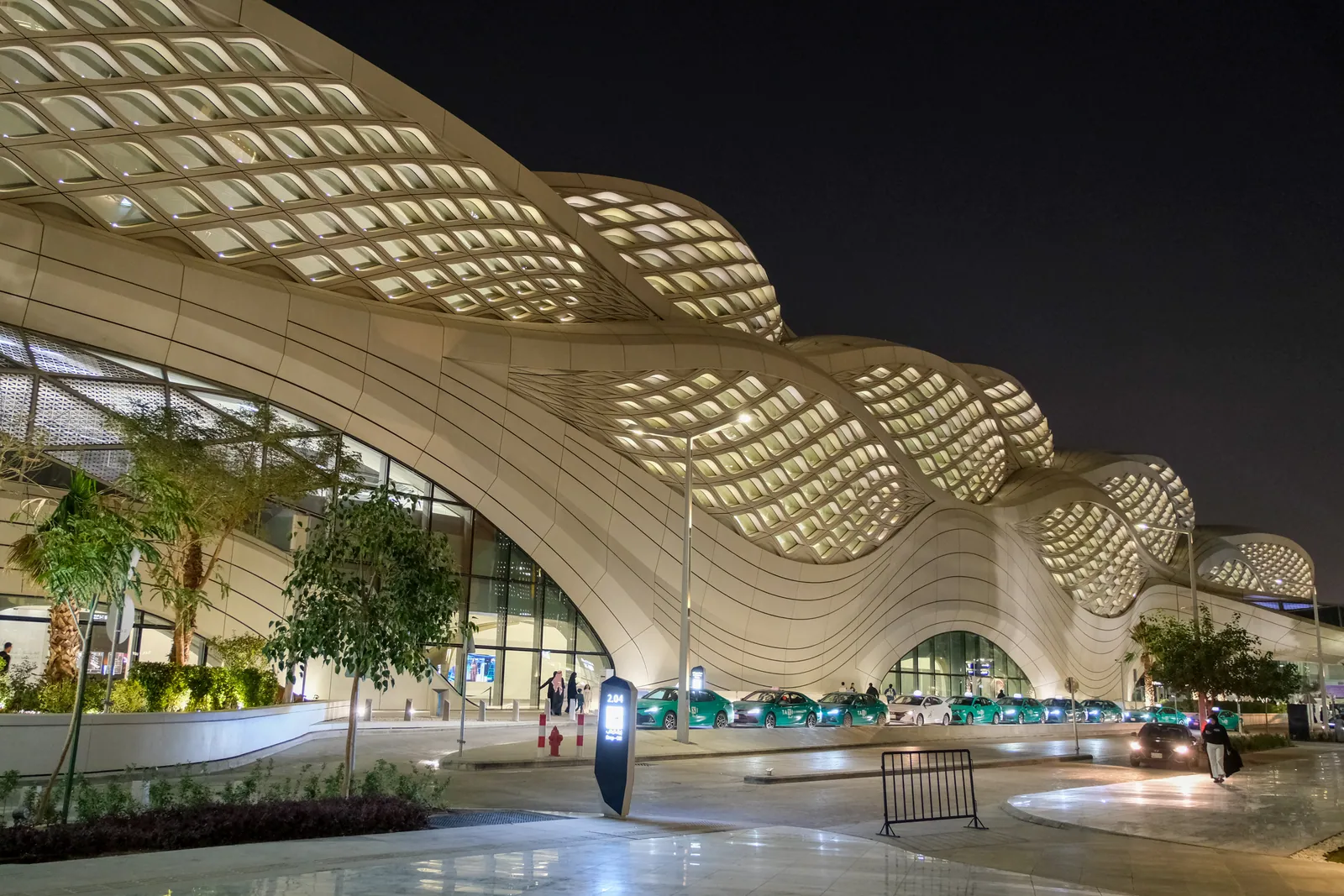
For most of its history Riyadh was a city you drove. Since December 2024 it has also been a city you can ride, and the change is bigger than the map suggests. If you live or work anywhere along King Fahd Road, arrive at the airport, or want to reach the old city without thinking about parking, the metro is now the easy answer. Here is how it works, which of the six lines you will actually use, and how to pay.
Fares, hours and figures below were checked in September 2026. The operator, Riyadh Public Transport, publishes changes on its app and its X account, and those are the final word.
Six lines, 85 stations, 176 kilometres, all driverless, which makes it the longest fully automated metro in the world. It opened in three waves: the Blue, Yellow and Purple lines on 1 December 2024, the Red and Green on 15 December, and the Orange on 5 January 2025. It carried its hundred-millionth passenger in August 2025, less than nine months in, and its two-hundred-millionth by March 2026, with a record 17.5 million rides in November 2025 during Riyadh Season. An extension of the Red Line to the east, 8.4 kilometres and five stations, has already been contracted.
| Line | Colour | Runs | Stations | What you will use it for |
|---|---|---|---|---|
| 1 | Blue | North to south along King Fahd Road, Olaya Street and Batha, from SAB Bank to Ad Dar Al Baida | 25 | KAFD, Olaya, the ministries, the old city. The spine. |
| 2 | Red | East to west along King Abdullah Road, from King Saud University to King Fahd Sports City | 15 | The university, the Riyadh Front side, Al Hamra and Ishbiliyah |
| 3 | Orange | East to west along Madinah Road, from Jeddah Road to Khashm Al An | 22 | Qasr Al Hokm and the souqs, Al Malaz, the SAR railway station for Dammam trains |
| 4 | Yellow | KAFD to the airport, all three terminal groups | 9 | Landing and leaving. About 39 minutes end to end |
| 5 | Green | Underground along King Abdulaziz Street, from the Ministry of Education to the National Museum | 12 | The government district and Sulaimaniyah |
| 6 | Purple | A half-ring from KAFD through the north-east to An Naseem | 11 | Granada, Al Yarmuk, Al Hamra and the compounds on the airport side |
The lines meet at a handful of interchanges. KAFD joins Blue, Yellow and Purple, which is why anyone living in the north ends up there. STC, in Olaya, joins Blue and Red. Qasr Al Hokm, in the old city, joins Blue and Orange. National Museum joins Blue and Green, Ministry of Education joins Red and Green, Al Hamra joins Red and Purple, and An Naseem joins Purple and Orange.
If you work in KAFD or Digital City and live in the north, the Blue Line is your commute. From Al Sahafah it is one stop; from Olaya it is four or five, about fifteen minutes with no traffic in the equation.
If you are arriving as a visitor, take the Yellow Line from the airport to KAFD, then the Blue Line south to Olaya for the hotels and restaurants, or on to Qasr Al Hokm for Masmak Fort, the National Museum stop for the museum and Murabba Palace, and Al Batha for the old markets. That covers most of a first visit without a single taxi. Diriyah, the other essential evening, is the exception: it has no station yet, so take a Careem from KAFD.
If you live in the north-east, in Granada, Al Yarmuk, Al Hamra or near the compounds along the Eastern Ring Road, the Purple Line gets you to KAFD and the Red Line gets you across King Abdullah Road.
If you are catching the train to Dammam, the Orange Line stops at the SAR railway station.
Fares are flat and time-based, not distance-based, and a metro ticket is also a bus ticket. Buy a two-hour ticket and you can ride any combination of metro lines and Riyadh Bus routes for two hours, with free transfers.
| Ticket | Regular | First class |
|---|---|---|
| 2 hours | SAR 4 | SAR 10 |
| 3 days | SAR 20 | |
| 7 days | SAR 40 | |
| 30 days | SAR 140 | |
| Annual | SAR 1,260 | SAR 3,150 |
| Student semester, four months | SAR 260 |
Children under six travel free. To pay, tap a mada, Visa or Mastercard, or a phone wallet, at the gate on the way in and out, and the two-hour fare is charged. For passes, use the Darb app, which also holds a digital Darb card, shows live routes and sells bus tickets, or pick up a plastic Darb card at any station. The annual and student prices took effect on 1 January 2026.
Trains run from 5:30 in the morning to midnight from Saturday to Thursday, and from 10 in the morning to midnight on Fridays, when the network starts after the midday prayer. Frequency is every three to five minutes at peak and five to ten minutes off-peak. Hours are extended during Ramadan; last year the network ran until 2:30 in the morning on weekdays and 3am on Fridays.
Stations are air-conditioned, with escalators and lifts, and the trains are cool in every month. The walk from your door to the station is the part of the journey the weather touches, so in July pick a station within ten minutes of home.
Every train has three kinds of carriage, marked on the platform and on the doors.
If you are unsure which door to use, staff on the platform will point you to the right one in a second, and nobody minds being asked.
Nineteen park-and-ride facilities sit beside metro and bus rapid transit stations, most holding several hundred cars. Parking is free for up to twelve hours as long as the same Darb card that paid for your parking also paid for your trip; after twelve hours it is SAR 10 an hour up to SAR 130 a day, and a car left more than 48 hours is towed. For anyone in Hittin or Al Malqa who works in the centre, driving to a Blue Line station and riding the rest is the fastest commute in the city.
Riyadh Bus fills the gaps between the lines: about 80 routes, three of them bus rapid transit corridors with their own lanes, and 58 feeder routes that run from residential districts to the nearest station. Same ticket, same app. Bicycles and e-scooters are not allowed on trains or buses.
We live at the northern end of the Blue Line, and it changed how our guests use the city. The two northern stations, SAB Bank and Dr Sulaiman Al Habib, sit along King Fahd Road at the edge of the district. From there:
| To | How | Roughly |
|---|---|---|
| KAFD | Blue Line, one stop | 3 minutes |
| Olaya and the STC interchange | Blue Line | 15 minutes |
| The National Museum and Murabba | Blue Line | 25 minutes |
| Qasr Al Hokm, Masmak Fort, the souqs | Blue Line | 35 minutes |
| The airport | Blue Line to KAFD, then Yellow Line | 45 minutes |
For a new arrival, that means the first week runs on a SAR 4 ticket: the airport, KAFD and the supermarket before you have a licence or a car. For anyone choosing where to live, it is one more reason the north makes sense.
For more on getting around, see our practical guides to Riyadh.
SAR 4 for a two-hour ticket in regular class, SAR 10 in first class. Passes cost SAR 20 for three days, SAR 40 for seven days, SAR 140 for thirty days and SAR 1,260 for a year. Fares are flat, not by distance, and every ticket also covers Riyadh Bus. Children under six ride free.
5:30am to midnight from Saturday to Thursday, and 10am to midnight on Fridays. Trains run every three to five minutes at peak and every five to ten minutes off-peak. Hours are extended during Ramadan.
Yes. The Yellow Line runs from all three terminal groups at King Khalid International Airport to KAFD in about 39 minutes, where it meets the Blue Line for Olaya and the centre and the Purple Line for the north-east.
Yes. Tap a mada, Visa or Mastercard, or a phone wallet, at the gate when you enter and leave, and the two-hour fare is charged. For multi-day passes, buy through the Darb app or a Darb card from any station.
Women, families and couples use family class; men travelling alone use singles class; anyone with a first-class ticket uses first class. The sections are marked on the platform and the train doors, and staff will direct you if you ask.
Not yet. The nearest station to the Boulevard is KAFD, about ten minutes by taxi, and Hittin and Al Malqa have no station. Park-and-ride at a Blue Line station is the practical answer for people who live there and work in the centre.
Staying near KAFD and want to try living car-free for a month? Our Al Sahafah apartments are a short walk from the Blue Line. Ask us which one is closest to the station.
Book a tourSIM, apps and a supermarket on day one. The medical and the iqama in week one. Bank, Absher, National Address and a car after. The order that saves you doubling back.
The districts north of KAFD, the compounds that keep coming up in expat forums, what a two-bedroom costs, and the one rule that saves you an hour a day: live near work.
Five months of concerts, rides, championships and 80-restaurant evenings, from October into spring. What is free, what is ticketed, and what is confirmed for 2026–27 so far.
Send your dates and how many of you there are. We'll reply with what's available, the rate for your stay, and photos of the actual apartment.